“HR can play their part in the AI transformation within organisations by preparing the workforce for change, rather than trying to support the technical implementation of the technology”.
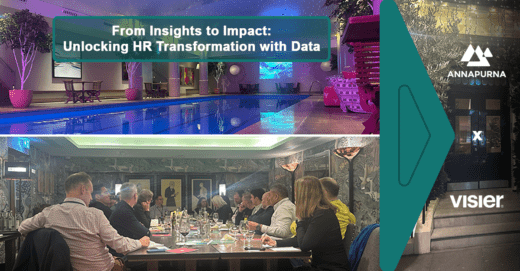
At our latest VIP roundtable event in central London, hosted by Joseph Nabarro (Interim Solutions Director at Annapurna), with expertise from Elliott King (Enterprise Account Executive at Visier) and Sean Pusey (Account Executive at Visier), we brought together 18 senior HR leaders to have an open and honest discussion around ‘The Velocity of Value: Harmonising AI & Human Potential in HR Transformation’.
In partnership with Visier, the global leader in AI-powered workforce planning and organisational design, the level of seniority of our attendees and the real-world examples Visier were able to add to the conversation, it’s no surprise that we uncovered some fantastic insights.
Three topics in particular stood out the most:
AI Adoption Fails or Succeeds Based on People, Not Technology
Many employees jump to the conclusion that the ability of the technology and results will be the defining factor in how well it’s adopted amongst the organisation. However, those in attendance agreed that this isn’t necessarily true.
Instead, the ultimate success of AI integration across the organisation relies solely on your people. If your teams aren’t convinced of the benefits of AI to their work and future outcomes, they will actively reject it.
There was a recurring theme amongst the leaders in the room that, yes, AI transformation is an organisational problem, but within that transformation, HR can play a pivotal role by ensuring the workforce is prepared for change. By doing this, HR increases the chances of adoption of the technology by leaning into the areas they know best (the people), instead of trying to involve themselves in the technological side of the transformation itself.
With this acknowledgement came the inevitable follow-up question: How do we prepare the workforce for said change?
Attendees agreed that there was no golden bullet here but a blended approach, including: identifying skillsets and internal mobility maps ready for changing roles and demands, keeping communication honest and clear about the direction and need for the technology, creating skill labs to help train employees about how to prompt and use AI better, and providing sandbox environments and ‘safe spaces’ for trial and error.
Starting With The Problem, Not The Tech
Another strong theme throughout the discussion was that too many organisations are starting with AI rather than taking a deeper dive into the ‘why’ behind the need for its integration.
With the speed at which AI not only came onto the scene, but also progressed since its inception, many executives have started demanding AI to be used within the organisation, simply to show it’s being used.
Our attendees reflected on how dangerous this perspective can be on the success of the technology, insisting that technology of any sort, but particularly AI, needs to be tied to business objectives/ goals, otherwise it’ll fall flat.
Not only does the objective make the route to success clearer, but it also enables the organisation to see the value and projected output of the technology early on, supporting adoption.
An example one attendee shared was around the use of an AI agent within their marketing team:
We deployed an AI agent to support our marketing team with their social listening. Rather than finding an excuse to implement the AI wherever, we spoke to the marketing team and tried to understand their biggest pain points as of now. Social listening was an extremely important task, but one that took our experts weeks to complete and kept them away from building actual marketing strategies that could create impact. With this in mind, we deployed the AI agent to do the social listening for them, resulting in research that used to take weeks, now just hours, and more time being spent on work that creates visible value.
AI Is Reshaping Roles, Skills, & Organisational Design
The scale of the capabilities of AI is still very much unknown due to us currently being in the early stages of its lifespan. There’s an easy misconception that’s gaining traction amongst employees (and society) that AI is being integrated to replace them and their work.
Although our leaders agreed that, of course, technology should be used to create efficiencies, headcount itself isn’t the end objective. If anything, those integrating AI so far have seen the opposite (an increase in headcount since adoption of the technology).
Rather than removing work, it’s changing it. Instead of skilled professionals spending time on ‘tasks’, AI is helping them focus purely on the higher-value work, which in turn is also making the work more fulfilling for employees.
With this, the conversation shifted slightly as many highlighted that one way AI will change jobs is within entry-level roles. The consensus was that entry-level roles won’t be eradicated as many are led to believe. Instead, it will just change the dynamic again, the same way it’s changed from 30 years ago, where an entry-level role involved filing paperwork. The future entry-level role could look like being a full-time AI prompter.
Conclusion
All things considered, one thing point remained strong: human oversight, judgement, and calibration remain imperative to business success, even in an AI-drive world.
Work will change, roles will be stretched and skills will be more important than ever, but the future world of work with the involvement of AI looks set to be the most productive and efficient we’ve ever seen. Employees will be completing fulfilling work and feel a greater sense of joy as a result.
The question for organisations now is how ready they are to invest in AI effectively with little reward now, in order to see a big impact in the future.