Greater reliability and clarity of payments would do more for job satisfaction than extra perks, according to 41% of employees in Remote’s 2026 Global Payroll Report. Yet in many organisations, the answer to “why was I paid this amount?” still depends on which system, team and spreadsheet you ask.
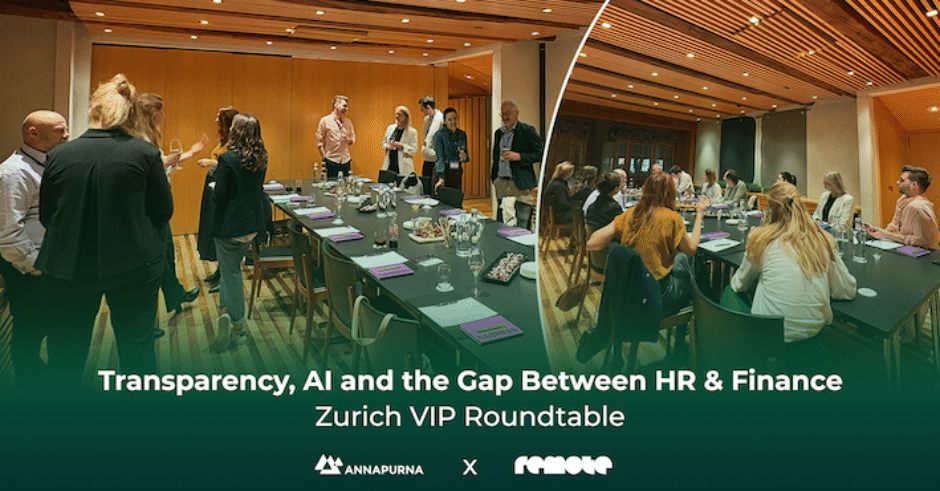
That tension was the focus of our recent VIP roundtable in Zurich, where senior HR and Finance leaders gathered to discuss Transparency, AI and the Gap Between HR & Finance. It was the second edition of this conversation, following our session in Munich, and we were proud to partner again with Remote through the presence of Nils Weitkämper and Sebastian Lukas Moron, with James Ballard (Managing Partner & Co-Founder at Annapurna) leading the discussion.
The two rooms had a lot in common. Both agreed that AI needs people alongside it, and that HR and Finance have to work together. In Zurich, our esteemed attendees we’re most eager to discuss how transparency is defined within HR compared to Finance, whereas in Munich, this was identified as one of the least important questions to those in attendance.
Using the insights shared during the conversation, here are the three takeaways we believe will matter most to HR and Finance leaders:
AI gives consistency, humans give context
As in Munich, the Zurich group saw real potential in AI to make pay and benefits more consistent. Our Zurich leaders also agreed with those in Munich on the importance of an element of human touch remaining in the process. The group were clear that the technology only works when people stay involved, with a few attendees pointing out that AI can’t apply the context and history behind compensation decisions that humans can, and that data needs a story attached to it more often than not.
Where our Zurich leaders went further was on accountability. When we asked who had a shared operating model between HR and Finance, nobody did. One leader described the two functions as “walking in parallel rather than together”, and another asked a question to the rest of the group that everyone agreed with:
Who fundamentally owns the decision? In many organisations, the honest answer is that it isn’t clear.
That ambiguity matters for any strategy, let alone its importance within an AI strategy. Structure and frameworks don’t guarantee fairness on their own, because pay outcomes are still shaped by who is making the decision and who is in the room.
Those in the room agreed that AI may not remove that, but it can force organisations to build a clearer process and document the reasoning behind decisions.
Transparency is about trust and culture, not more data
This was the sub-topic that our Zurich leaders wanted to discuss most, whereas our Munich leaders showed less interest in it, possibly highlighting the differences in approaches amongst organisations headquartered in each country, most likely due to legal legislation.
While most conversations relating to transparency end up underlining the importance of having more data at our disposal, those in attendance quickly moved away from this and towards culture instead.
Giving people more data doesn’t make an organisation transparent. It becomes transparent when people trust each other enough to share information and know how to use it well.
Our leaders noted that in some organisations, managers have no access to the data they need, while forecasts are built at the top and kept there. Without visibility, there is little accountability for managers’ decisions, and every question about pay lands back with HR. Given the lack of expectation to share pay information in Switzerland compared to that amongst EU countries, there was a consensus around the table that this was a cultural problem rather than a practical one.
This is a real contrast with Munich, where the EU Pay Transparency Directive was a driver, pushing leaders to get their data in order. In Zurich, with no equivalent legal requirement, the push has to come from within, from leaders who decide that openness is worth building.
Adding to this, our Munich roundtable highlighted the importance of the underlying data being complete and reliable in order to build transparency. Our Zurich discussion added a culture version of this on top, with many in the room agreeing that a single source of truth matters, but only is people are willing to use it.
Bridging HR and Finance means connecting people decisions to business strategy
Our Zurich leaders agreed with the conclusion of the Munich roundtable that HR and Finance are talking about the same thing in different languages. While shared data, tools and even languages matter, the group felt the real work and reward lies within connecting workforce decisions to business strategy, financial outcomes and organisational capability.
With Finance thinking in cost centres and budgets, whilst HR thinks in people, job architecture and growth, it’s no surprise the two may share data needs, but come to different conclusions. One attendees summarised this perfectly by highlighting that for every problem there could be up to 18 different solutions, depending on who you ask and when.
There was also a shared recognition around the table that HR is still treated as a cost centre, even though people costs are the most significant a business carries. To counter this, some in the room argued that HR owning the employment cost, rather than the full forecast could bring HR to the table in a way not yet seen, which could indirectly help the two functions begin to see eye-to-eye.
Two questions the group felt every leadership team should be asking to support this bridge between the functions was:
- Who owns the decisions? Is accountability for pay and workforce cost clear between HR and Finance?
- Does Finance understand our performance philosophy? It shapes pay outcomes, yet is often hard to explain across functions.
Conclusion
Across Munich and Zurich, the message is consistent.
AI can create clarity, but transparency and fairness are built by people. What differs is where each room starts. Munich’s leaders were focused on fixing processes and using AI in practical ways ahead of regulation. Zurich’s were focused on culture, ownership, and who gets to see the numbers.
Either way, the organisations making progress are those that agree who is accountable, define what transparency means to them, and get HR and Finance working from the same data and the same goals.
To learn more about how Remote helps organisations simplify global payroll and HR, click here.