In twelve months’ time, all of our roles could look completely different from today.
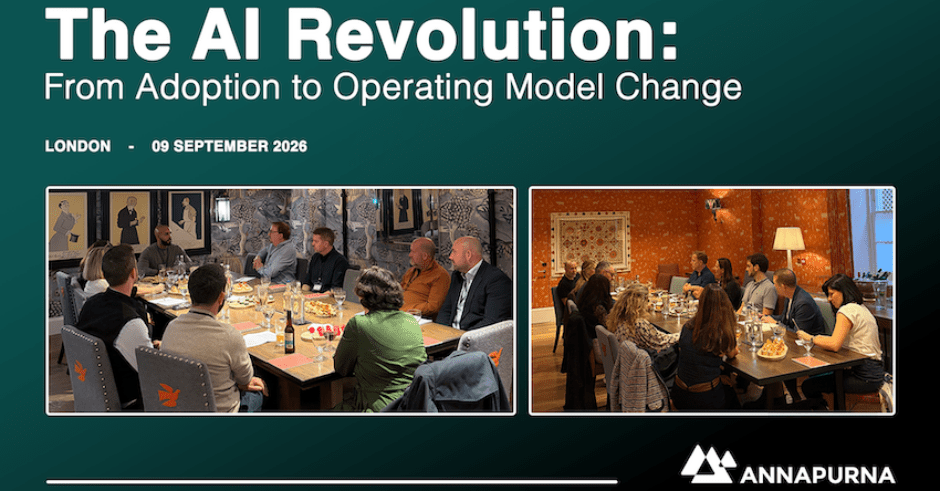
That was a great way of summarising the thoughts of the room as we brought together senior HR, Technology and GTM leaders to discuss how AI is not just reshaping how we work, but the work itself too.
Hosted in London, the conversation ranged from AI washing to the question of who actually owns AI strategy and what happens to the next generation of talent when the work and the environment they used to learn from disappears.
AI washing is a bigger threat than AI itself
With the speed at which AI has changed work, there’s no surprise to see question marks thrown out by influential figures recently, asking if we should slow down the rate at which we’re moving. Sam Altman, CEO of OpenAI, said himself recently that people have a good reason to be ‘worried about AI’, but that ultimately, they should trust AI organisations.
The room agreed with this, stating that the danger of AI is not in the technology itself, but in organisations declaring “AI can do this now” without any form of strategy behind it. The consensus was that AI should be viewed as a support role that partners with people to help them upskill, rather than being a blunt replacement tool.
A big reason the room identified a lack of AI strategy among organisations is the up-front cost. Building AI into processes is often more costly and time-consuming than relying on a human. You only uncover the true potential and wins further down the line.
That’s a large reason as to why younger businesses are pulling ahead in adopting AI effectively. A company built from scratch and designed around AI from day one makes it easier to excel, rather than trying to transform existing ways of working in organisations that existed before the technology arrived. Established organisations are carrying existing people and infrastructure into the transition, making it a trickier starting position, but not an excuse to skip the strategy step.
Ownership of AI cannot sit within one function or one person
There was one topic the room was convincingly aligned on, and that was that AI leadership cannot sit solely within IT, HR, or a single person. The group strongly agreed that there needs to be a leader in the organisation overseeing the AI direction, but this should be a collective of leaders rather than one individual.
There was an understanding that organisations will typically look to their Technology leads as they are the most enabled, but that doesn’t automatically make them the best positioned.
Developers aren’t necessarily wired to weigh up risk the way AI adoption demands. Effective change needs a blend of business knowledge, technical understanding, and change management.
This extends to the workforce itself, with organisations redesigning how AI shapes the roles required within the business and future planning. Our attendees likened the movement we’re going through now to the changes seen in the early 2000’s when the internet reshaped work. Before every business evolved to be online, ‘e-commerce marketing director’ was never a role that existed until the market demanded it.
Increased working speed is heightening burnout
The leaders in attendance were candid about their own experiences with AI, noting that one of their biggest pain points was feeling fatigued by it.
With AI changing the pace at which work can be turned over, and with review time being significantly shorter, by the time something is off your desk, it’s back again. The usual rest you have in between to switch priorities isn’t there anymore. Our attendees also noted that it’s extremely addictive to continuously prompt and improve AI, going back and forth until, before you know it, you’ve spent your evening in work mode still.
Overall, our leaders acknowledge that, left unmanaged, this creates a huge problem where individuals are not switching off enough to come back to work the next day feeling refreshed.
The fix discussed wasn’t switching AI off, but adding structure instead. Clear expectations for when work is due and can be reviewed, as well as explicit policies around instant messaging, so teams aren’t left guessing what’s acceptable.
A side discussion that stemmed from this was the future risk of AI removing repetitive, lower-value tasks people have traditionally learned through and how this jeopardises the next generation of talent.
Though there was no clean answer for this yet, many of the leaders emphasised the need to protect junior talent as they think totally differently to older workers. This is a huge advantage when it comes to AI, as they test without any reservations based on preconceived thoughts that older workers are more likely to dismiss automatically.
Conclusion
What came through clearly from the conversation was that AI has to be built with purpose and strategy, otherwise it will fall flat and create more noise/ leak resources than it saves.
Strategy has to come before speed, ownership has to be shared rather than parked with one function, and the human pipeline that builds future expertise needs protecting more than ever.
The organisations that get this right won’t be the ones with the flashiest AI tools. They’ll be the ones that treated this time of change as an operating model question from the start, not a technology rollout.