“No one knows with certainty what AI or regulation will look like five years from now. So basing a compensation strategy around
speculative capabilities or rules is a risk most organisations can’t afford to take.” – beqom’s 2025 Compensation & Culture Report
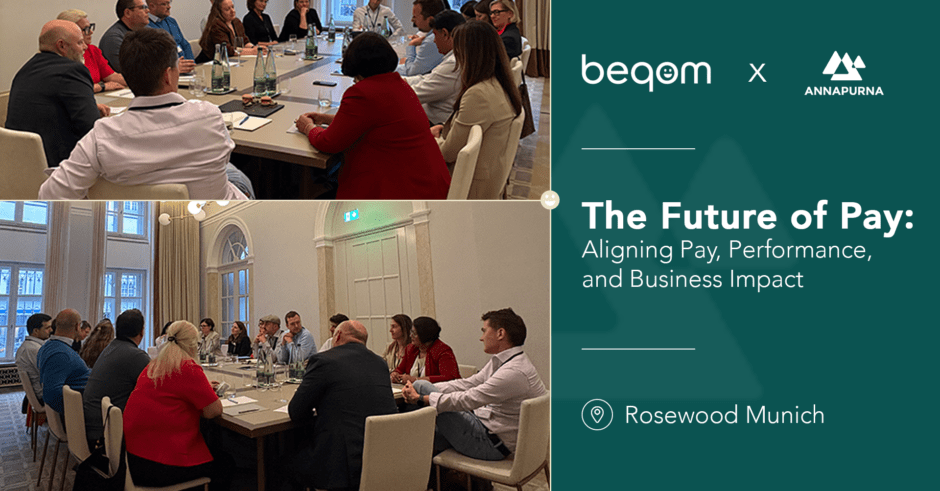
James Ballard (Director & Founder at Annapurna) led a fascinating conversation of senior Reward leaders for a discussion titled ‘The Future of Pay: Aligning Equity, Performance and Business Impact’. This topic of conversation may have been reignited by the EU Pay Transparency Directive, yet the evolution of the workforce and the technological capabilities we now have at our fingertips are more likely to be the instigators for a discussion about how we can create fairness across our pay offerings.
Bringing expertise to the conversation were Pius Fellner (Head of DACH Sales at beqom) and Stephan Pohl (CRO at beqom) who provided a wide range of insights as representatives of beqom.
There were three key takeaways from the conversation, which are outlined below:
Nobody can agree on what ‘fair’ means and that’s the real problem
The question that stopped the room wasn’t about data or technology. It was a simpler one; ‘What is fair pay, what is your philosophy, and what does it look like?’ For many organisations around the table, the honest answer was that no clear philosophy exists and that absence is quietly driving a lot of downstream pain. The EU Pay Directive definitely echoes this methodology and serves as a stepping stone towards managing the complexities of pay.
Non-standardised pay ranges were flagged as a persistent, nagging issue across the board. Legacy decisions, negotiation power, and internal politics have left pay structures that are hard to explain and harder to defend. One framing that resonated with the group was the idea of a ‘buffet’ approach to job architecture. In this example, it’s about here’s what’s on offer and take whatever aspect suits your role. In this instance, fairness is defined as people getting what they need within the same framework, with the same resources available to them.
The group landed on a pragmatic but important distinction: ‘Consistency helps the case of fairness, transparency is the first step’. Chasing a perfect, universal definition of fair pay may be the impossible dream. Building compensation frameworks that apply the same logic, the same criteria, and the same language consistently…that’s achievable.
Generational pressure is undoubtedly heightening the sense of urgency on this topic. Younger employees are entering organisations with high expectations and very little appetite for ambiguity. One attendee noted that Gen Z “have experienced all the big dramas, they want to achieve things much faster.” They’re already asking AI tools what they should be paid. They want clarity on role expectations, visible career paths, and rapid development, not just a salary. As one leader put it, the new generation doesn’t want any uncertainty in their role. For reward leaders, that’s not just a retention challenge; it’s a signal that the old frameworks for explaining and defending pay decisions are no longer fit for purpose.
Transparency doesn’t necessarily equal fairness. The group agreed that fairness is subjective and therefore hard to perfect. Instead, they recommended that organisations should focus on creating a clear compensation philosophy, communicate it well, and apply it consistently.
Retaining talent requires more than a pay rise, but what about the development piece?
A recurring thread across the conversation was the cycle that many organisations find themselves trapped in: bring in talent on competitive salaries, face demands for rapid progression, fail to deliver it quickly enough, and watch people leave, often to a competitor who benefits from the investment you made in developing them. “You don’t want to become the university for your competitors” landed as one of the sharpest lines of the session.
The group was clear that pay alone doesn’t solve the retention problem. Pay is not explicitly the reason people leave; a pay rise probably buys time, but it doesn’t address what people are actually looking for, which is movement, development, and the sense that they’re making an impact. This is particularly acute with the newest generation of employees who arrive with niche, high-value skills but within job architectures that weren’t built to accommodate them or reward their progression quickly enough.
Large organisations move slowly by design; a change that benefits the individual is difficult to implement at pace across a whole company without creating new inequities. Meanwhile, job architecture is changing faster than most organisations can track, driven by AI reshaping what roles actually require. One attendee described it vividly as “It used to be a game of Tetris, but now we have no idea how roles will look.”
Clear job descriptions and well-defined expectations are becoming more important, not less. They’re the baseline against which growth and success can actually be measured. Without them, development conversations become abstract, and the case for staying becomes harder to make.
Pay alone won’t retain your newest or next generation of talent; organisations that win won’t necessarily be those paying them the most, but those creating the clearest pathways for growth and development, complemented by great reward plans.
AI in Reward has potential, but it’s time to think differently
There was genuine excitement in the room about what AI could eventually mean for compensation and reward, but matched with an equally genuine scepticism about where it actually is today. The prevailing mood: AI is still largely being used under external pressure, deployed because organisations feel they have to be seen to use it, rather than because it’s solving a clearly defined problem. Using it for using’s sake.
The current reality for most is that AI is being applied to eliminate repetitive tasks: processing data, flagging anomalies, streamlining admin. Useful, but not transformational. The more ambitious possibility is using AI to rethink job architecture entirely, pulling in external market data, internal skills profiles, and performance outputs to generate role definitions from the ground up. This is where the real conversation is headed, but few are there yet. As one leader put it, “AI is just an enabler, you need to have your processes, outcomes and data in order to make it valuable.”
Two specific challenges stood out.
First, data quality: AI can only work as well as the inputs it’s given, and if those inputs carry existing bias or inconsistency, AI doesn’t neutralise that, it amplifies it.
Second, scale: AI used well at the individual or team level is genuinely powerful, but translating that into a consistent, compliant, organisation-wide approach is an entirely different challenge. This is one most Reward functions haven’t yet solved.
The future of pay is undoubtedly directly related to skills and tasks. Reward strategies built around fixed job architectures may quickly become outdated in an AI-driven workplace. Create frameworks that can adapt as the work changes will align with the generational shift organisations are going through.
To learn more about beqom, please visit their website here.