HR and Finance running off the same operating model is no longer just a nice to have. With regulation such as the EU Pay Transparency Directive demanding data that sits across both functions, it is fast becoming a compliance need.
Yet in most organisations, the two still operate in silos, with different priorities and data. If transparency is the goal, HR and Finance have to come together, and AI can only improve processes to extend the transparency once they do.
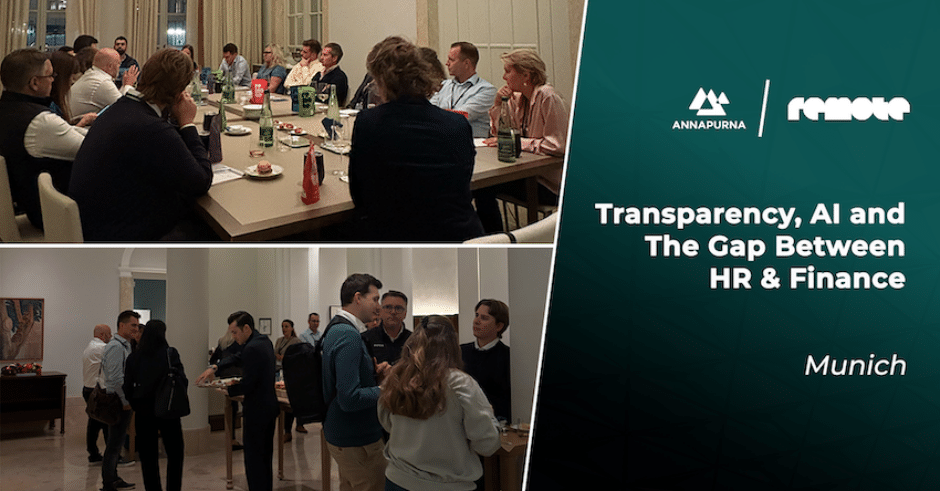
That was the theme running through our recent VIP roundtable in Munich, where senior HR and Finance leaders gathered to discuss ‘Transparency, AI and The Gap Between HR & Finance’.
We were fortunate to have Remote, the financial operating system for the global workforce that helps you pay the world, partner with us to bring this event to life. Their expert knowledge around the table through the presence of Nils Weitkämper and Kai Pröse enabled the conversation to move beyond theoretical ideas/concepts and delve into real world solutions to the challenges leaders in the room were experiencing.
Amongst the insights shared, three areas stood out that we think will matter most to senior business leaders:
AI gives consistency, humans give context
Now that AI is more established within organisations, the room was refreshingly direct about where it actually creates value, and where it simply adds complexity and busy work with little to show for it.
The leaders agreed that the most practical use case is the HR assistant. AI delivers the most value when it has a clear set of black-and-white rules to follow, which makes it well suited to acting as an FAQ bot for HR and Finance teams. Rather than sending employees through endless slide decks, documents and intranet searches to find answers to policy, pay and process, a bot can answer in an instant, in one place.
One attendee explained that they had already built something similar after employees’ differing views on how things worked became a major blocker to transparency.
Despite the optimism, a few important points were made about how far its use should go.
- Keep the bot to FAQs: It can explain what a policy says, but it cannot give deeper explanations when the question posed to it becomes more complicated than regurgitating information. The judgement needed for complex questions, such as differences in pay within the organisation, needs context, and context needs a person.
- Pay transparency needs data you can trust: With the EU Pay Transparency Directive adding pressure, leaders noted that AI can only help if the underlying information is complete and reliable, which is often not the case yet. Getting there is step one.
- Humans stay at the final stage: Good decisions still need a human and a well-built database behind them. Setting the goals and parameters AI works within remains a human job, and communication still works best face-to-face rather than through email.
One leader summed up the group’s view perfectly:
We’re looking to use AI for clarity and humans for fairness. Automation will grow, and so will the importance of the human touch.
HR and Finance are talking about the same thing in different languages
When the conversation inevitably turned to the gap between the two functions, the honest consensus was that it is wide, especially for organisations operating across borders, where culture, operating models and consistency all differ.
Despite this, there was broad agreement that the two should come together and work from the same operating model. The functions are closely linked, but no one was blind to the fact that they run on different priorities, which makes bringing them together harder. HR focuses on people, experience and freedom, whereas Finance centres on the balance sheet and efficiency. Leaders saw that difference as a potential game changer, if both functions could find a way to work towards one shared target.
The strengths also run both ways. Leaders argued that HR needs to become more analytical and strategic, and that the future of the function depends on it. Finance holds the data HR desperately needs and can teach HR how to use it analytically, which is a natural trait of financial teams. In return, Finance can learn from HR how to be more creative with its data, helping to solidify its position at C-suite level.
Broken processes don’t get fixed by automation, they just fail faster
The final theme explored AI in a mature way. Leaders were clear that AI does not repair broken processes and should not be plugged into them for ‘the sake of it’. Since AI’s inception, this has been a growing issue amongst organisations, where they add AI to look advanced, but without any real plan or structure.
The biggest problem that occurs from this attitude towards AI is that, when layered on top of broken processes, it expedites mistakes rather than solving them.
This ties back to an example an attendee mentioned earlier, whose employees all had a different view of how things worked. Leaders recognised that as a process issue, not a technology one. They fixed it first, making sure communications and policies matched, and only then added the AI bot on top to answer questions. Had they gone straight in with the bot, confusion would have been amplified rather than suppressed.
The conversation then moved to what organisations actually gain from automating certain jobs and tasks. The leaders emphasised that just because you can automate something doesn’t mean you should. Before automating any process, leadership should define the end goal, and if the automation doesn’t directly serve that goal, it isn’t worth doing right now. The challenge here, is in order for HR & Finance to work closely together, they need to agree on the same goal.
Conclusion
Following the conversation, it was clear that the room strongly agreed that AI can create clarity, but transparency and fairness are built by people.
The organisations making progress are not necessarily the ones adopting the most technology, but those fixing their processes first and getting HR and Finance working from the same data, the same language and, ideally, the same operating model, so that AI has something solid to build on.
If you’re interested in learning more about Remote and their services, click here.