Hiring is becoming more data-led, more technology-enabled, and despite outside noise claiming otherwise, more human.
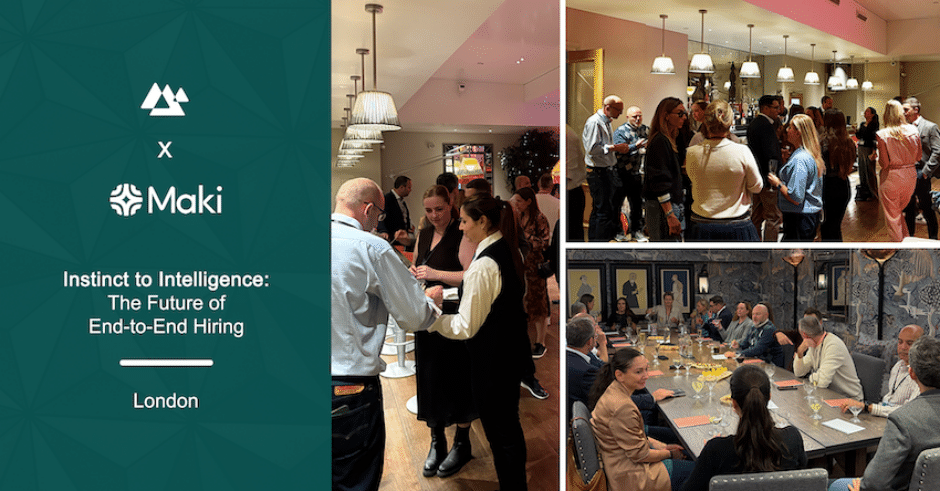
That was the spine of the conversation at our recent VIP event in London, which brought together senior talent leader from some of the largest enterprise organisations to explore ‘Instinct to Intelligence: The Future of End-to-End Hiring’.
We were fortunate to have MakiPeople, an AI-driven talent acquisition and recruitment intelligence platform, partner with us to bring this event to life. Their expert knowledge around the table through the presence of Molly Lawrence and Marc De Wind enabled the conversation to move beyond theoretical ideas/concepts and delve into real world solutions to the challenges leaders in the room were experiencing.
Amongst the insights uncovered, three areas stood out that we think will matter most to talent and HR leaders:
Hiring is moving back into the room
The extremely hot topic of candidate fraud was the catalyst for this discussion.
Attendees described everything from hidden text on CVs designed to game screening tools to AI assistance running quietly during video interviews as the key threats they’re increasingly experiencing. One leader even shared that they had someone completely different from the person who interviewed throughout the hiring process turn up for day one in the role.
Beyond the obvious fraudulent threats, the interesting story that came from this conversation was the operational changes organisations are now making in response.
For many years now, technology advancements have encouraged organisations to host more and more of their hiring process remotely. However, our leaders in the room emphasised that they’re now actively re-incorporating in-person interviews as a mandatory stage of the process.
A few weighted points were made:
- Video can open the process, but someone has to be seen in person eventually. Several leaders were clear that, at some point, face-to-face contact is now essential.
- Location can’t be a barrier. One participant mentioned that their organisation now requires candidates to attend a local office for interviews. Where this isn’t possible, candidates must go to an approved partner location the business has agreements with.
- Your interviewers need new skills. Recruiters and hiring managers are now being given dedicated training to help them recognise the signs of AI use, so detection doesn’t rest on technology alone.
- Fairness has to be designed in. Tools that rely on eye contact or eye movement risk disadvantage neurodivergent candidates, so organisations need to ask what they are really measuring.
The table agreed that despite onlookers seeing this as a form of stepping backwards in time, it’s the complete opposite in truth. Technology is still used in new areas and ways, but human judgement has simply become more important than ever before, too. This means the organisations winning are the ones willing to redesign their end-to-end process to incorporate both.
Meeting talent where they are
Perhaps one of the most striking changes in the room was in how organisations are approaching talent attraction now.
For years, the model was to post a role and wait for the right people to apply. Now, our leaders around the table agreed that they’re putting focus on going out and finding the talent themselves, and in some cases they are starting to look like mini agencies.
At the centre of this conversation was a change in where organisations look initially. Leaders are now using AI to build detailed personas of the people they want to hire, and to identify the social touchpoints where those people spend their time beyond traditional platforms such as LinkedIn.
An engineer with a brilliant skillset and experience at some of the world’s largest organisations may not have a LinkedIn profile at all, but they will almost certainly have a GitHub account, and a presence on other developer and AI tools they use every day.
This example given by a participant highlights how, if an organisation can identify the connecting areas where talent lies beyond traditional platforms, they have a new way of hiring talent that simply wasn’t findable before.
Despite the use of AI to find talent, our leaders were quick to point out the limitations of the technology, emphasising that it is not yet ready to complete the first approach for said talent. The initial contact between an organisation and a candidate largely hinges on trust, which can only be developed meaningfully with the use of a human touch.
The CV is dead. What happens when it goes?
Our leaders were quick to move on to the use of CVs and largely agreed that they have been ‘dead’ for some time now, yet still hold a significant part in the hiring process.
Ultimately, most agreed that if you have 500 applications for one role, you need to have a way of dwindling that number down to at least 20 of the best, but CVs are a poor tool for assessing skills and performance, so it’s not fair to do this based on that information alone. That said, regulation makes it hard to remove entirely, and alternative options such as questionnaires or surveys immediately put passive candidates off applying.
The second point to come from this part of the conversation was around candidate experience. People are reluctant to invest time in an assessment or hiring process when they expect nothing back. A process that asks more of a candidate than a CV needs to give more in return too. Our leaders were clear that this responsibility lies in the hands of HR and talent acquisition.
While the answer that will result in the best outcome is still under testing by many, most agreed that now is the time to refine the process, not just patch it.
Conclusion
Throughout the evening, the same principle emerged: technology should support decisions, not make them. The organisations getting this right are not necessarily the ones adding the most AI, but those redesigning their end-to-end hiring process to include intentional AI, people, and data.
If you’re interested in how MakiPeople can support you in achieving this, click here.