AI has the potential to accelerate an array of hiring processes but it has also made trust harder to establish.
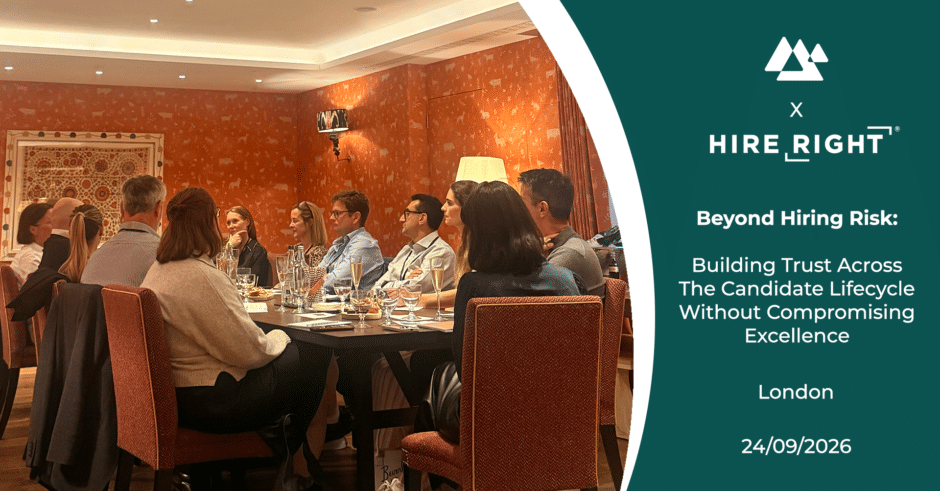
This train of thought was ever present as we brought together an esteemed group of People leaders to debate how we build trust across the workforce lifecycle without compromising excellence.
We were privalaged to partner with one of the leading organisations in this space, HireRight, and were joined by Lisa Lee and Richard Homes to provide some subject expertise around the table.
The conversation was candid and wide-ranging, which resulted in three takeaways that stood out.
Keep pace with AI, but keep people at the centre
AI is always innovating, with something new arriving almost daily. The question is no longer whether to use it, but how to keep pace with it and use it to protect ourselves, our businesses and wider society.
The group agreed that trust matters most where it is part of the brand itself. For organisations in pharma, healthcare and professional services, getting this wrong is not just a hiring problem; it is a reputational one. Recruitment remains a “people by people” profession, and that human element should lead everything else.
There was some focused conversations around executive and specialist hiring being still largely traditional, while mass recruitment having embraced AI far more readily. AI should be delivering improvements and giving people time back in their diaries, yet several leaders felt its benefits are being diluted by scaremongering and bureaucracy.
There is also a growing “tech vs tech” battle. Many felt candidates are ahead of recruiters in their adoption of AI, and sometimes in their manipulation of it.
A few points stood out:
- We are applying AI to today’s problem, not yesterday’s. The hiring process has changed, so simply automating the old process misses the point.
- Be clear on the why. If an organisation is aiming for a specific level AI usage, it should be able to explain what that target is for.
- Use AI to personalise, not just process. As hiring journeys become more bespoke, technology can help create a better, more tailored candidate experience.
Don’t let volume outpace judgement
Applying for jobs is easier than ever, and that directly drives up the number of applicants per vacancy. When one role attracts thousands of interested people, candidates will do everything they can to be seen: optimising CVs with AI, exaggerating achievements, and more. Organisations need to respond so that volume doesn’t undermine their ability to separate strong candidates from genuine threats.
The challenge is sharpened by location-agnostic roles. When you can hire from anywhere, filtering with confidence becomes harder, and separating “lazy apply” submissions from genuine applicants quickly is a real operational problem.
The group’s view was that the answer starts with getting the basics right:
- Be wary of false efficiencies. Cutting screening interviews in the name of speed often just moves the problem further down the process.
- Bring back early human contact. Several leaders asked whether face-to-face interviews should be mandatory at early stages. Candidates are increasingly asking for it too; one guest said 95% of their first-round interviews now take place in the office.
- Keep a human eye on CVs. Some questioned whether there should be an expectation to review every CV in person rather than relying solely on technology.
- Consider ID verification at the point of application. Supermarkets, retailers and applications on our devices already hold our data, so why not a prospective employer? A strong candidate should have little issue with it, and the group felt candidates would share more data willingly if it meant a shorter, more transparent process.
Verification matters because fabrication has become easy. With the acceleration of technology and AI, anyone can produce convincing university certificates or proof of achievements, for example. One guest shared an example of a candidate who claimed to have worked at Meta and supplied a payslip as proof. The giveaway: for the years in question, the company was still called Facebook.
Trust isn’t a one-off check
Passing pre-employment checks and receiving an offer doesn’t mean someone should be trusted indefinitely. The group agreed that organisations should use post-hire screening to reverify suitability throughout a person’s tenure, and that the risks posed by internal employees are often misunderstood.
The gap is widest beyond the permanent workforce. Contractors are rarely performance managed on an ongoing basis, and when risk is outsourced to a third party, it is tempting to look away from a lot more. Screening consistency across contractors, consultants and suppliers was seen as a clear blind spot.
The discussion raised several practical questions for People leaders:
- Are you acting on what screening finds? Pre-employment screening succeeds when it flags something, but it is then up to the organisation whether it acts.
- How verified are your references? Reference screening loses much of its value when the documents collected aren’t independently checked.
- Should screening be continuous? Could employees be rescreened regularly, for example annually?
- Do you know what else people are doing? Moonlighting checks came up as a growing consideration.
The overriding message was the need to stay at the forefront of a changing landscape, including awareness of risks surfacing on the deep and dark web.
Building security without friction
Across all three themes, the common thread was balance. Stronger controls don’t have to mean a slower or more off-putting process. Simpler tech stacks, earlier human contact and shorter, more transparent journeys can raise trust on both sides while protecting employer brand.
For additional insight into current screening, hiring and workforce risk trends, you may find HireRight’s latest Global Benchmark Report useful, featuring findings from organisations around the world.