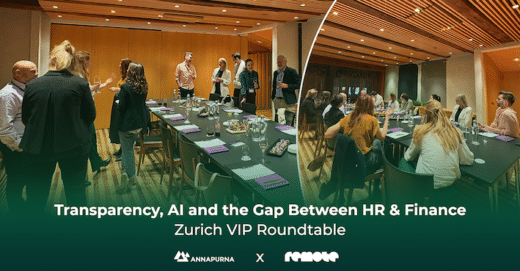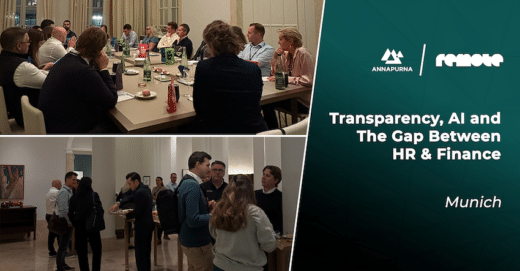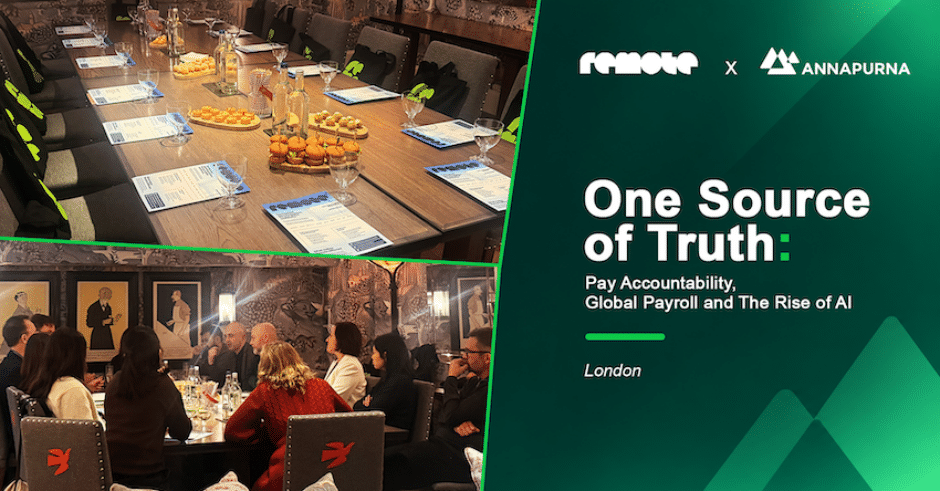
We were recently delighted to partner with Remote, the intelligent infrastructure for employing and paying people everywhere, for the 3rd and final in our series of events across Europe around ‘one source of truth’.
Bringing together some of the brightest minds across HR, Reward and Payroll, the session was hosted by James Ballard (Founder and Director at Annapurna), with expertise brought to the table from Rebecca Applewhite (Director, Solutions Consulting at Remote) and Matt Morley (Senior Account Exec at Remote).
The conversation brought about the following takeaways:
One source of truth is a prerequisite, not a project
Every organisation at the table was somewhere on a data journey, and none described it as finished, which it never should be. The questions that cut through were deliberately unglamorous: what data is coming in, what data is going out, and is any of it being brought into one place? Until those have answers, conversations about AI capability are potentially premature.
Payroll sits at the centre of this because it is almost certainly the most sensitive data any organisation holds. That sensitivity creates a paradox the room recognised immediately. The dataset most capable of producing genuine insight: on cost, on benchmarking and on how reward tracks market movement. Yet, this is frequently the one AI is forbidden to touch. Leaders described spending hours manually assembling insight from data a model could have interpreted in minutes, blocked not by capability but by governance written before the question arose.
The practical constraint was equally candid. Most HR functions are not choosing between sophisticated platforms; they have Copilot (for example) and a mandate to make something of it. The real question is what you can meaningfully embed with the tools already paid for, rather than what you might do with tools you will never be given budget for.
What has genuinely changed is what products can now do unprompted. Agents that flag anomalies (for example, payments that do not look right, variances that do not reconcile) represent capability that did not exist in any practical form two years ago. However, none of it works on data you cannot trust. Get the single source of truth right, and the AI conversation becomes straightforward. Skip it, and every tool you buy (or build) inherits the same unreliable foundation.
Accountability does not outsource
One leader proposed a statement lined with humour but with truth at the core: payroll is like deodorant; you should never notice it until it stops working. Nobody has ever been complimented for getting payroll right. The asymmetry is severe, however, whereby the consequences of getting it wrong are disproportionate, and in any international business with multiple jurisdictions, vendors and employment models, the opportunities to get it wrong multiply.
Accountability was where the conversation became most interesting. The instinctive answer is joint responsibility between HR and Finance, and most of the room agreed in principle. In practice, when something breaks, the finger points at the Payroll champion or the HR function, because they are the ones standing in front of the employee. Outsourcing does not change this. When you outsource, you only ever hand over a portion of the information; you keep the rest, and you keep the accountability with it.
What employees want turns out to be modest. Not necessarily more pay, and not access to everyone else’s information. Clarity of process and visibility of their own position would be the wins. The question of whether an AI assistant answering pay, benefits and deductions queries instantly would cost something human divided the room, but the more precise framing was about judgement: where does it start and end? Few routine queries require human judgement at all. They require a fast, accurate, traceable answer, and the human currently exists largely because the system cannot provide one.
A single platform where employees engage with their own data through an agent was seen as a credible pivot and progression as part of an improved employee experience. Employee happiness begins with being paid correctly and on time. That is not a soft observation. It is the foundation everything else is built on.
AI should educate, not just automate
The most animated part of the discussion was not solely about payroll. It was about what happens to people who learn their craft in an environment where AI is always available. The concern was specific rather than general.
Experienced professionals trust AI output because they have years of context to measure it against; they can look at a result and know instantly that it does not make sense. Someone without that grounding puts a question in, receives an output, and has no basis for judging it. The answer may be wrong in ways that are obvious to a colleague with a decade behind them and invisible to the person who produced it. Has AI made things too easy for people who do not yet understand the underlying work?
The room’s response was not to restrict access but to redesign how people learn. AI should be educational. It should support pipeline development. Junior people should be able to make mistakes in a controlled environment with immediate feedback built in. This creates an environment where employees are learning faster than they otherwise would, rather than learning less.
The organisational test was neatly put: you should be able to identify AI slop anywhere in your business at any moment. If nobody can, you have a quality problem you cannot see. On the opposite side of the conversation, one leader spoke about how their AI integration had got to a point whereby if someone had done a task and it looked like AI hadn’t helped, then you may get called out. Organisations are aspiring to do more with less and if employees are not willing to innovate their thinking and create efficiencies, money is being lost.
Around 2500 years ago, Socrates argued that writing weakens human memory and creates an illusion of wisdom rather than true understanding. This same argument is now rearing its head with the rise of AI and whether the use of it will create a generation of employees who can only answer via a bot. The truth is, if you aren’t using it and going on the journey, you are guaranteed to be left behind.
To read more about where Remote thinks the role of AI is going and its impact on the HR function, with a specific focus on Payroll and Reward, please check out their recent Global Payroll Report below:
https://remote.com/resources/research/global-payroll-report